COMPLETE RESEARCH GUIDEPEPTIDE PEN
BPC-157
Regeneration Research Peptide
>99%10 mgFROM EUR 119BEST SELLER
QUICK ANSWER
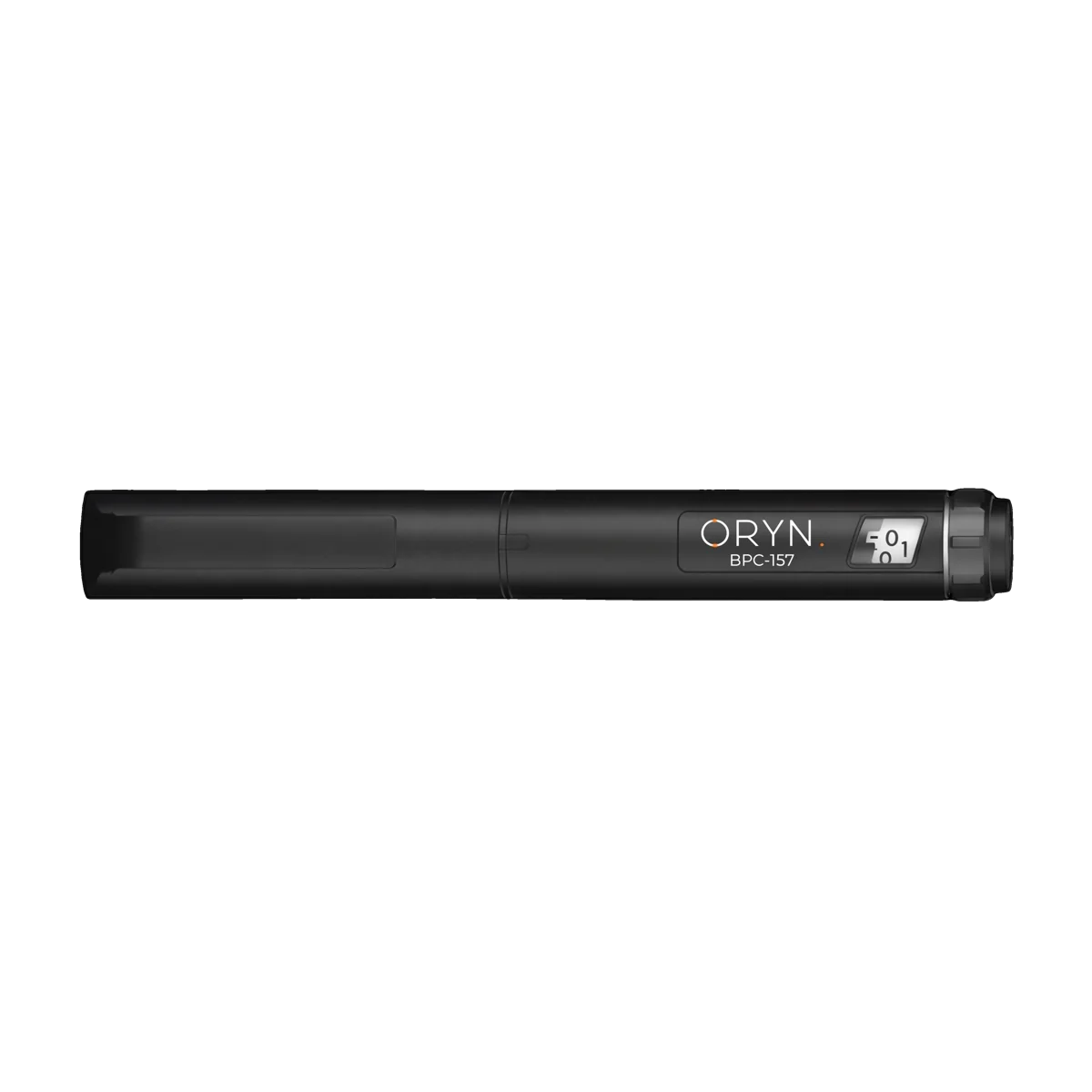
BPC-157 (regeneration research peptide) is a >99% purity research compound. A pentadecapeptide widely studied in tissue regeneration and gastrointestinal research. Research suggests BPC-157 may modulate nitric oxide pathways and growth factor expression. ORYN delivers BPC-157 in a precision-dosed reusable pen starting from EUR 119. All products are for research purposes only.
Science & Research
FULL ENCYCLOPEDIA ENTRY →MOLECULAR PROFILE
FORMULA
C62H98N16O22
WEIGHT
1419.53 Da
CLASSIFICATION
Gastric Pentadecapeptide
STUDIES CITED
4 key studies
Mechanism of Action
BPC-157 exerts its biological effects through multiple interconnected pathways. At the molecular level, it modulates the nitric oxide (NO) system, promoting vasodilation and angiogenesis — the formation of new blood vessels — in injured tissue. This enhanced blood supply is critical for delivering oxygen and nutrients to damaged areas, accelerating the healing process.
READ FULL MECHANISM →Key Published Studies
2006
Stable gastric pentadecapeptide BPC 157 in trials for inflammatory bowel disease
Demonstrated significant healing of inflammatory bowel lesions in animal models with oral and parenteral administration.
2014
Pentadecapeptide BPC 157 enhances the growth hormone receptor expression in tendon fibroblasts
Showed BPC-157 upregulates GH receptor expression, promoting tendon cell proliferation and collagen synthesis.
2019
BPC 157 and the NO system in the healing of damaged tissues
Established the central role of nitric oxide modulation in BPC-157's healing mechanism across multiple tissue types.
2010
BPC 157 counteracts the effect of NSAIDs on the gastrointestinal tract
Demonstrated complete reversal of NSAID-induced gastric lesions and intestinal damage in rat models.
Research History
BPC-157 was first isolated from human gastric juice in the early 1990s by a research team at the University of Zagreb, led by Professor Predrag Sikiric. The discovery that a stable gastric peptide fragment could accelerate wound healing across multiple tissue types attracted significant scientific interest.
FULL RESEARCH HISTORY →ORYN BPC-157 Product
PEPTIDE PENBEST SELLER
BPC-157 — Regeneration Research Peptide
A pentadecapeptide widely studied in tissue regeneration and gastrointestinal research. Research suggests BPC-157 may modulate nitric oxide pathways and growth factor expression. ORYN BPC-157 delivers 10mg in a precision-dosed reusable pen system with replaceable cartridges for 30 days of consistent administration.
PURITY
>99%
FILL VOLUME
3 mL
DOSAGE
10 mg
FORMULATION
Pharma Grade
DOSING PERIOD
30 Days
STERILIZATION
0.22um Filter + Gamma Ray
EUR 119VIEW PRODUCT DETAILS
Articles & Guides
ALL ARTICLES →LEGAL & COMPLIANCE
Are Peptides Legal in the UK? Complete 2026 Guide
Understanding the legal landscape of research peptides in the United Kingdom. What you need to know about purchasing, possessing, and using peptides in 2026.
8 min read
GUIDES
Peptide Pen vs Vial: Which Is Better for Research?
A detailed comparison of peptide pen systems versus traditional vials for research applications. Why pre-mixed pens are becoming the new standard.
6 min read
PEPTIDE RESEARCH
BPC-157: Complete Research Guide 2026
Everything researchers need to know about BPC-157 — from its molecular mechanism to the latest published studies and optimal research protocols.
10 min read
GUIDES
How to Use a Peptide Pen: Step-by-Step Guide
Step-by-step instructions for using ORYN peptide pen systems. From unboxing to administration, everything you need to know.
5 min read
PEPTIDE RESEARCH
Best Peptides for Recovery in the UK (2026)
A comprehensive look at the leading recovery peptides available for research in the UK, with detailed comparisons and protocol considerations.
7 min read
PEPTIDE RESEARCH
GHK-Cu: The Copper Peptide Revolution for Skin Research
A deep dive into GHK-Cu — the copper-binding peptide transforming skin research. From collagen stimulation to wound remodelling, discover why researchers are turning to this remarkable tripeptide.
9 min read
Head-to-Head Comparisons
ALL COMPARISONS →COMPARISON
BPC-157 vs TB-500: Which Recovery Peptide Is Better?
BPC-157VSTB-500
Both peptides excel at different aspects of recovery. BPC-157 is stronger for gut healing, tendon repair, and neuroprotection. TB-500 is superior for wound healing, cardiac repair, and inflammation. Many researchers use both together for comprehensive recovery protocols.
COMPARISON
Peptide Pen vs Injection Vial: Which Delivery Method Is Better?
BPC-157VSTB-500
Pre-mixed peptide pen systems are superior to traditional vial + syringe in virtually every category that matters for research quality: dosing precision, contamination risk, convenience, and consistency. The only advantage of vials is lower upfront cost — but this comes at the expense of accuracy, sterility, and usability. ORYN's pen systems eliminate the guesswork and risk inherent in manual reconstitution.
COMPARISON
BPC-157 vs GHK-Cu: Recovery Peptide vs Skin Repair Compared
BPC-157VSGHK-CU
BPC-157 and GHK-Cu serve fundamentally different primary purposes. BPC-157 is the gold standard for internal tissue recovery — gut healing, tendon repair, and neuroprotection. GHK-Cu excels at skin and structural protein repair — collagen synthesis, wound healing, and anti-aging. Choose based on your primary research focus, or consider both for comprehensive tissue repair protocols.
COMPARISON
GHK-Cu vs BPC-157: Skin Repair vs Tissue Recovery Compared
GHK-CUVSBPC-157
GHK-Cu is the superior choice for skin repair, collagen synthesis, and anti-ageing research. BPC-157 is the stronger option for internal tissue recovery — gut healing, tendon repair, and neuroprotection. They target different tissue systems with minimal overlap, making combination protocols highly logical for researchers studying comprehensive tissue repair.
COMPARISON
BPC-157 vs CJC-1295: Recovery Peptide vs Growth Hormone Peptide
BPC-157VSCJC-1295
BPC-157 is the stronger choice for direct tissue recovery — gut healing, tendon repair, and neuroprotection through growth factor modulation. CJC-1295 is the better option for growth hormone optimisation — body composition, sleep, and systemic recovery via sustained GH release. They work through entirely different pathways and are commonly stacked for comprehensive recovery protocols.
COMPARISON
BPC-157 vs NAD+ for Recovery: Tissue Repair vs Cellular Energy
BPC-157VSNAD+
BPC-157 and NAD+ support recovery through completely different biological layers. BPC-157 directly repairs damaged tissue — tendons, gut lining, nerves — through growth factor modulation and angiogenesis. NAD+ restores the cellular energy and DNA repair capacity needed for all recovery processes. BPC-157 fixes the damage; NAD+ powers the machinery that enables repair. Together, they create one of the most comprehensive recovery protocols available.
COMPARISON
Pre-mixed Peptide Pens vs Traditional Injections: Complete Comparison
BPC-157VSTB-500
Pre-mixed peptide pen systems are the clear winner for modern research applications. They eliminate reconstitution errors, reduce contamination risk, provide precision dosing, and save significant time. Traditional vial and syringe methods offer lower upfront cost and the ability to custom-mix concentrations, but introduce dosing variability, contamination risk, and preparation complexity that compromise research quality. For reproducible, reliable research, pen systems are the evidence-backed choice.
COMPARISON
BPC-157 vs GHK-Cu: Tissue Repair vs Skin & Hair Regeneration
BPC-157VSGHK-CU
BPC-157 dominates deep tissue repair -- tendons, gut lining, nerves -- while GHK-Cu is the clear leader for skin rejuvenation, hair follicle stimulation, and structural protein remodelling. They target fundamentally different tissue layers and are highly complementary for researchers studying whole-body regeneration.
COMPARISON
BPC-157 + TB-500 Stacking Guide: Synergy for Recovery Research
BPC-157VSTB-500
BPC-157 and TB-500 form the most widely used recovery peptide stack in the research community. Their mechanisms are not just different but genuinely synergistic: BPC-157 stimulates growth factors and directly promotes repair, while TB-500 builds the vascular and cellular migration infrastructure needed to deliver repair cells to damage sites. Together, they consistently outperform either peptide alone in recovery research models.
Research Protocols
ALL PROTOCOLS →RECOVERY
8-12 weeksBPC-157 + TB-500 Recovery Protocol
The Gold Standard Tissue Repair Stack
BPC-157TB-500
WELLNESS
6-8 weeksBPC-157 Gut Healing Protocol
Gastrointestinal Mucosal Repair & Integrity
BPC-157
RECOVERY
8-12 weeksBPC-157 Joint & Tendon Protocol
Musculoskeletal Connective Tissue Repair
BPC-157
PERFORMANCE
12-16 weeksCJC-1295 + Ipamorelin + BPC-157 Athletic Protocol
Performance, Recovery & Growth Optimization Stack
CJC-1295IpamorelinBPC-157
Frequently Asked Questions
FULL FAQ →What is BPC-157 and where does it come from?
+
BPC-157 (Body Protection Compound-157) is a synthetic 15-amino acid peptide derived from a protective protein naturally found in human gastric juice. It was first isolated by researchers at the University of Zagreb and has been studied extensively for its regenerative and cytoprotective properties across multiple tissue types.
What is the mechanism of action of BPC-157?
+
BPC-157 works through multiple pathways: it modulates the nitric oxide system to promote blood vessel formation, activates the FAK-paxillin pathway for cell migration and repair, upregulates growth factors (VEGF, EGF, FGF) for tissue regeneration, and provides cytoprotection in the gastrointestinal tract. It also interacts with dopaminergic and serotonergic systems.
What research has been conducted on BPC-157?
+
Over 100 peer-reviewed studies have investigated BPC-157, primarily in animal models. Research spans tendon and ligament healing, gastrointestinal protection, neuroprotection, wound healing, bone repair, and inflammatory bowel disease. Human clinical trials are limited but preclinical results are consistently positive.
How does ORYN deliver BPC-157?
+
ORYN BPC-157 is delivered via a precision peptide pen system containing 10mg in 3mL, formulated at pharmaceutical grade with >99% purity. The pen provides consistent dosing over 30 days, eliminating the need for reconstitution and reducing contamination risk compared to traditional vial-and-syringe methods.
What is BPC-157?
+
BPC-157 is a synthetic pentadecapeptide (15 amino acids) derived from a protective protein found in human gastric juice. It has been extensively studied in preclinical research for its potential role in tissue healing, gut protection, and anti-inflammatory activity. ORYN BPC-157 is formulated at >99% purity in a precision-dosed pen system.
How does BPC-157 work?
+
Research suggests BPC-157 may modulate multiple biological pathways including nitric oxide synthesis, growth factor expression (such as VEGF and EGF), and the FAK-paxillin signalling cascade. These mechanisms are thought to contribute to its observed effects on angiogenesis, tendon healing, and gastrointestinal protection in preclinical models. Note: these findings are from research studies and do not constitute medical claims.
What is BPC-157 used for in research?
+
BPC-157 is studied across a broad range of research applications including gastric ulcer healing, tendon and ligament repair, muscle injury recovery, bone fracture healing, neuroprotection, and inflammatory bowel conditions. It is one of the most versatile peptides in regenerative medicine research.
How is ORYN BPC-157 administered?
+
ORYN BPC-157 is delivered via a pre-mixed peptide pen system. Each pen contains 10 mg of BPC-157 in 3 mL, designed for subcutaneous injection. The pen system eliminates the need for manual reconstitution, reducing contamination risk and ensuring precise, consistent dosing throughout the 30-day protocol.
Explore More ORYN Products



RESEARCH PURPOSES ONLY. All content on this page is intended for informational and educational purposes for qualified researchers. ORYN products are not approved as medicines and are not intended for human therapeutic use. Do not use ORYN products for self-administration. Consult relevant regulations in your jurisdiction.