A peptide pen looks more expensive than a vial on the sticker — until you add up BAC water, syringes, sharps disposal, training time, and the doses wasted to reconstitution errors. The real numbers, cleanly broken down.
10 min read · Updated 2026-04-14
Why the sticker price lies
Every research-chemical comparison that starts and ends with 'pens cost more than vials' is measuring the wrong thing. The honest cost metric for a research lab isn't the price of the peptide — it's the total cost per completed research protocol, which is the sum of the peptide itself plus every consumable, every minute of researcher time, and every wasted dose from reconstitution or syringe error.
When you run that calculation for an ORYN peptide pen against a traditional vial workflow, the delta shrinks to roughly 5–15%, and in some protocols the pen is actually cheaper because the wasted-dose term for a vial workflow is surprisingly large. This article walks through the full calculation with real numbers.
The vial workflow: hidden line items
A 10 mg BPC-157 vial from a typical supplier costs around €50–70 depending on brand and shipping origin. That's the number every comparison stops at. Here's what the researcher actually spends to turn that vial into administered doses:
- Bacteriostatic water: €3–5 per 5 mL vial (enough for 2 peptide reconstitutions) - Syringes: €0.30–0.50 per 1 mL syringe, one per dose - Pen needles / alcohol swabs: €0.15–0.25 per dose - Sharps disposal: €0.10 per dose amortised over a €15 sharps box - Reconstitution error waste: statistically ~10–15% of the vial value lost to concentration miscalculation across a 30-day study - Researcher time: ~5 minutes per dose for reconstitution and syringe draw, versus ~15 seconds for a pen click
If you multiply the 30-day protocol out — one dose per day for 30 days — the total added cost from the above line items lands around €18–24 on top of the vial sticker price. That turns a €60 vial into a €78–84 real cost.
FEATURED PRODUCT
BPC-157 — Regeneration Research Peptide
10 mg · >99% purity · GMP
The pen workflow: what you actually pay
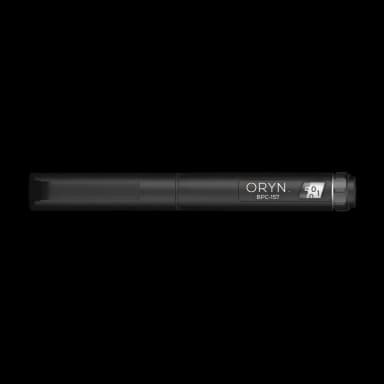
An ORYN BPC-157 peptide pen ships at €119 in the EU, €85 in the UK. The line items attached to each dose are simpler:
- Pen needle: €0.10–0.30 per dose (BD Micro-Fine Ultra 32G × 4 mm) - Alcohol swab: €0.05 per dose - Sharps disposal: €0.10 per dose amortised - Zero reconstitution waste: the pen is pre-mixed at the factory with no researcher error - Researcher time: ~15 seconds per dose (no calculation, no reconstitution)
Over the same 30-day protocol, those extras add €7.50 on top of the €119 sticker. Total real cost: €126.50.
So a pen costs €126.50 vs a vial workflow cost of €78–84. The pen is €42–48 more expensive for a 30-day protocol, which is a 50–60% premium on sticker price but represents a dramatically better research workflow.
When the premium is worth paying
The answer to 'is the €42 pen premium worth it' depends on three things: how much you value your research time, how much your protocol depends on dose reproducibility, and whether you have any downstream publication or audit obligations.
Research time: If you're running a 30-day protocol with one dose per day, the pen saves about 2.5 hours of researcher time compared to vial reconstitution and syringe drawing. For a postdoc at €45/hr fully-loaded, that's €112.50 of time saved — which more than pays for the €42 pen premium on its own.
Dose reproducibility: Pens deliver <2% variance per click. Vials deliver ±8–12% variance from syringe technique. If your protocol's effect size is in the 10–20% range, vial variance eats a meaningful chunk of your statistical power, which means you need larger sample sizes to detect the same effect — and larger samples cost more than the pen premium ever will.
Audit and publication: Pen batches are traceable with a printed batch ID on the cartridge and a matching COA in the box. For research that might be audited, published, or replicated, that chain of custody is non-negotiable. Vial workflows with researcher-added BAC water produce an audit trail that's much harder to reconstruct.
When vials still win
The case for vials in 2026 is narrower than it used to be, but it's not zero. Vials are still the right call if:
- You're running a protocol at very high volume (hundreds of doses) and the reconstitution workflow has been engineered into an automated liquid-handling system — the per-dose vial cost is unbeatable at that scale. - You need access to a niche research compound that simply isn't available in pen format from any supplier. - You're early-stage and need to minimise per-week cash outlay until a grant cycle closes.
For most researchers running standard protocols on BPC-157, TB-500, Tirzepatide, NAD+, GHK-Cu, CJC-1295, Ipamorelin, or Glutathione, the pen format is the better economic choice once you do the full math.
ORYN pen pricing by product and currency
Here's the at-a-glance pricing for every ORYN pen in the catalogue, shown in the four currencies we bill in:
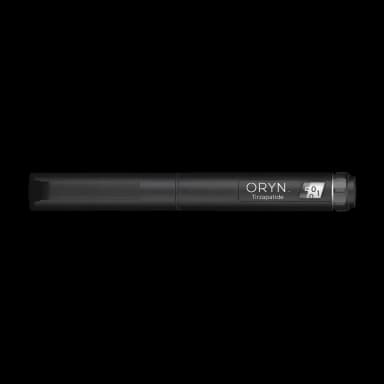
- BPC-157 Pen — £99 UK · €119 EU · $129 US · R$599 BR - TB-500 Pen — £99 UK · €119 EU · $129 US · R$599 BR - CJC-1295 Pen — £89 UK · €109 EU · $119 US · R$549 BR - Ipamorelin Pen — £89 UK · €109 EU · $119 US · R$549 BR - GHK-Cu Pen — £115 UK · €139 EU · $149 US · R$699 BR - Tirzepatide Pen — £139 UK · €169 EU · $179 US · R$849 BR - Glutathione Pen — £85 UK · €99 EU · $109 US · R$499 BR - NAD+ Pen — £159 UK · €189 EU · $199 US · R$949 BR - MediT Tirzepatide (40 mg) — £209 UK · €249 EU · $269 US · R$1249 BR - NovaDose NAD+ (150 mg) — £249 UK · €299 EU · $319 US · R$1499 BR
All prices include duty-paid shipping, the Certificate of Analysis, and the 30-day money-back guarantee. Free shipping thresholds: £130 UK, €175 EU, $175 US, R$750 BR.