COMPLETE RESEARCH GUIDEPEPTIDE PEN
TB-500
Cell Migration Research Peptide
>99%15 mgFROM EUR 119
QUICK ANSWER
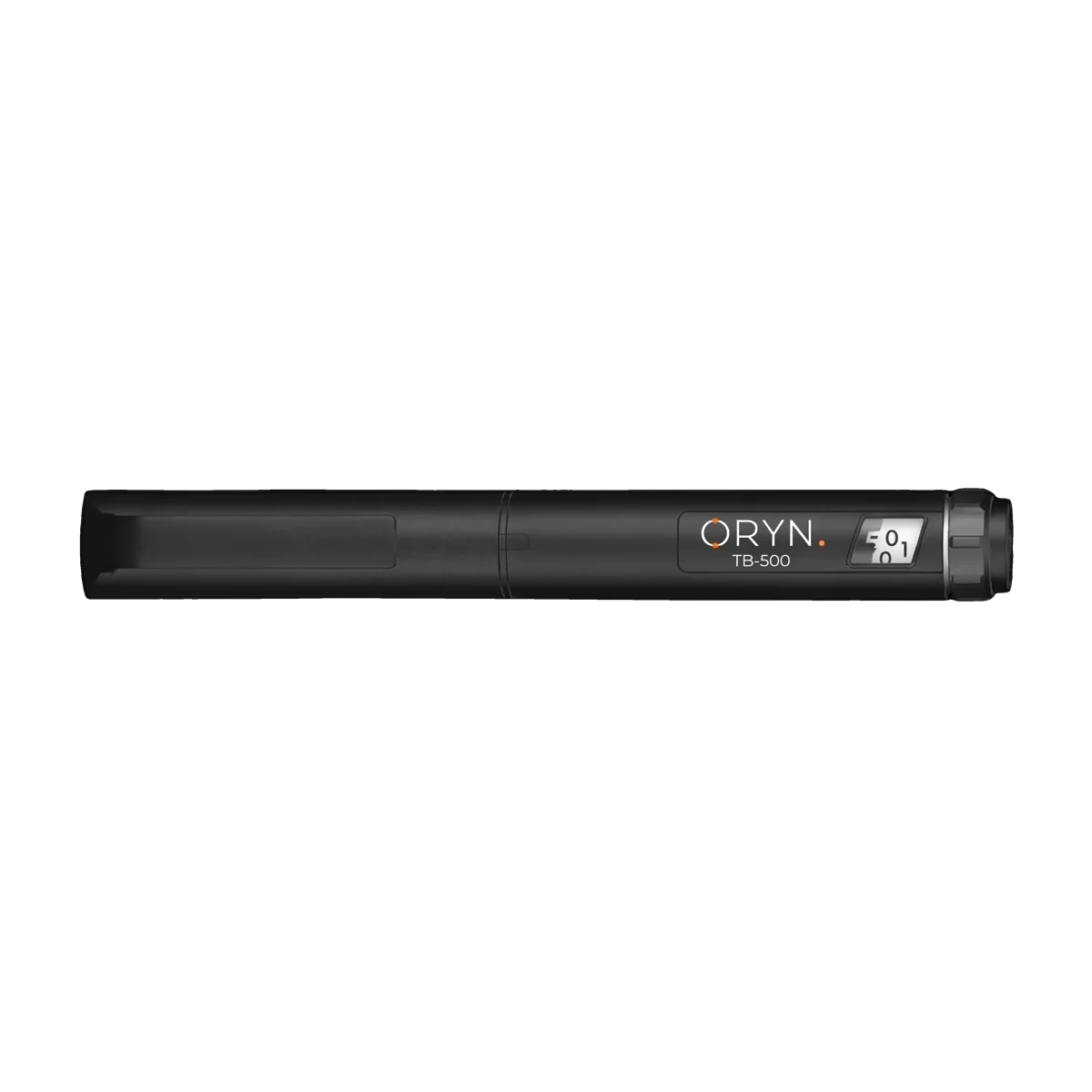
TB-500 (cell migration research peptide) is a >99% purity research compound. A Thymosin Beta-4 fragment studied for its role in cell migration and actin regulation. Research suggests TB-500 may promote angiogenesis and modulate inflammatory pathways. ORYN delivers TB-500 in a precision-dosed reusable pen starting from EUR 119. All products are for research purposes only.
Science & Research
FULL ENCYCLOPEDIA ENTRY →MOLECULAR PROFILE
FORMULA
C212H350N56O78S
WEIGHT
4963.44 Da
CLASSIFICATION
Thymic Peptide / Actin-Binding Protein Fragment
STUDIES CITED
4 key studies
Mechanism of Action
TB-500 is a synthetic version of the naturally occurring 43-amino acid peptide Thymosin Beta-4 (TB4), focusing on the active region responsible for actin binding and cell motility. Its primary mechanism involves binding to and sequestering monomeric actin (G-actin), which plays a central role in cellular migration, proliferation, and differentiation.
READ FULL MECHANISM →Key Published Studies
2004
Thymosin beta-4 promotes cardiac cell migration, survival and cardiac repair
Demonstrated TB4 activates cardiac progenitor cells and promotes heart tissue repair following myocardial infarction in mice.
2007
Thymosin beta-4 accelerates wound healing in diabetic mice
Showed significant acceleration of wound closure and re-epithelialisation in diabetic mouse models, a notoriously difficult healing context.
2010
Anti-inflammatory effects of thymosin beta-4
Established TB4's ability to downregulate NF-kB signalling and reduce pro-inflammatory cytokine production in multiple tissue models.
2012
Thymosin beta-4 reduces fibrosis and promotes tissue regeneration
Demonstrated reduced scar tissue formation and improved functional tissue recovery in cardiac and dermal injury models.
Research History
Thymosin Beta-4 was first isolated from the thymus gland in the 1960s by Allan Goldstein and colleagues. Initially studied for its role in immune regulation, researchers later discovered its profound effects on wound healing and tissue repair. The synthetic fragment TB-500 was developed to capture the most bioactive region of the full protein.
FULL RESEARCH HISTORY →ORYN TB-500 Product
PEPTIDE PEN
TB-500 — Cell Migration Research Peptide
A Thymosin Beta-4 fragment studied for its role in cell migration and actin regulation. Research suggests TB-500 may promote angiogenesis and modulate inflammatory pathways. ORYN TB-500 delivers 15mg in a reusable pen system designed for optimal bioavailability over 30 days.
PURITY
>99%
FILL VOLUME
3 mL
DOSAGE
15 mg
FORMULATION
Pharma Grade
DOSING PERIOD
30 Days
STERILIZATION
0.22um Filter + Gamma Ray
EUR 119VIEW PRODUCT DETAILS
Articles & Guides
ALL ARTICLES →LEGAL & COMPLIANCE
Are Peptides Legal in the UK? Complete 2026 Guide
Understanding the legal landscape of research peptides in the United Kingdom. What you need to know about purchasing, possessing, and using peptides in 2026.
8 min read
GUIDES
Peptide Pen vs Vial: Which Is Better for Research?
A detailed comparison of peptide pen systems versus traditional vials for research applications. Why pre-mixed pens are becoming the new standard.
6 min read
PEPTIDE RESEARCH
BPC-157: Complete Research Guide 2026
Everything researchers need to know about BPC-157 — from its molecular mechanism to the latest published studies and optimal research protocols.
10 min read
GUIDES
How to Use a Peptide Pen: Step-by-Step Guide
Step-by-step instructions for using ORYN peptide pen systems. From unboxing to administration, everything you need to know.
5 min read
PEPTIDE RESEARCH
Best Peptides for Recovery in the UK (2026)
A comprehensive look at the leading recovery peptides available for research in the UK, with detailed comparisons and protocol considerations.
7 min read
GUIDES
Peptide Storage Guide: Temperature, Shelf Life & Best Practices
Proper peptide storage is critical for maintaining potency and research reliability. Learn the best practices for temperature control, shelf life management, and safe transport.
7 min read
Head-to-Head Comparisons
ALL COMPARISONS →COMPARISON
BPC-157 vs TB-500: Which Recovery Peptide Is Better?
BPC-157VSTB-500
Both peptides excel at different aspects of recovery. BPC-157 is stronger for gut healing, tendon repair, and neuroprotection. TB-500 is superior for wound healing, cardiac repair, and inflammation. Many researchers use both together for comprehensive recovery protocols.
COMPARISON
Peptide Pen vs Injection Vial: Which Delivery Method Is Better?
BPC-157VSTB-500
Pre-mixed peptide pen systems are superior to traditional vial + syringe in virtually every category that matters for research quality: dosing precision, contamination risk, convenience, and consistency. The only advantage of vials is lower upfront cost — but this comes at the expense of accuracy, sterility, and usability. ORYN's pen systems eliminate the guesswork and risk inherent in manual reconstitution.
COMPARISON
TB-500 vs Ipamorelin: Recovery Peptide vs Growth Hormone Secretagogue
TB-500VSIpamorelin
TB-500 and Ipamorelin serve fundamentally different purposes. TB-500 is a direct tissue repair peptide that promotes cell migration and wound healing. Ipamorelin is a selective growth hormone secretagogue that triggers natural GH pulses. Researchers focused on acute recovery choose TB-500; those studying GH-mediated effects — body composition, sleep, anti-ageing — choose Ipamorelin. They can also be combined for comprehensive recovery-plus-growth protocols.
COMPARISON
TB-500 vs CJC-1295: Wound Healing vs Growth Hormone Releasing
TB-500VSCJC-1295
TB-500 excels at direct tissue repair — wound healing, angiogenesis, and reducing inflammation at injury sites. CJC-1295 stimulates sustained growth hormone release for body composition, recovery, and anti-ageing research. They target different biological systems and are frequently combined in advanced protocols.
COMPARISON
TB-500 vs GHK-Cu for Wound Healing: Which Heals Better?
TB-500VSGHK-CU
TB-500 and GHK-Cu both promote wound healing but through different mechanisms. TB-500 excels at the early stages — cell migration, angiogenesis, and inflammation reduction. GHK-Cu excels at the remodelling stage — collagen synthesis, scar reduction, and structural protein restoration. For comprehensive wound healing research, the combination covers both phases of the healing process.
COMPARISON
Pre-mixed Peptide Pens vs Traditional Injections: Complete Comparison
BPC-157VSTB-500
Pre-mixed peptide pen systems are the clear winner for modern research applications. They eliminate reconstitution errors, reduce contamination risk, provide precision dosing, and save significant time. Traditional vial and syringe methods offer lower upfront cost and the ability to custom-mix concentrations, but introduce dosing variability, contamination risk, and preparation complexity that compromise research quality. For reproducible, reliable research, pen systems are the evidence-backed choice.
COMPARISON
BPC-157 + TB-500 Stacking Guide: Synergy for Recovery Research
BPC-157VSTB-500
BPC-157 and TB-500 form the most widely used recovery peptide stack in the research community. Their mechanisms are not just different but genuinely synergistic: BPC-157 stimulates growth factors and directly promotes repair, while TB-500 builds the vascular and cellular migration infrastructure needed to deliver repair cells to damage sites. Together, they consistently outperform either peptide alone in recovery research models.
Research Protocols
ALL PROTOCOLS →Frequently Asked Questions
FULL FAQ →What is TB-500 and how is it related to Thymosin Beta-4?
+
TB-500 is a synthetic peptide that replicates the active region (LKKTET domain) of Thymosin Beta-4 (TB4), a naturally occurring 43-amino acid protein. While TB4 is produced throughout the body, TB-500 isolates the key fragment responsible for cell migration, wound healing, and anti-inflammatory effects.
What is the mechanism of action of TB-500?
+
TB-500 works primarily by binding to G-actin, modulating the cytoskeleton to enhance cell migration to injury sites. It promotes angiogenesis (new blood vessel formation), reduces pro-inflammatory cytokines, and uniquely reduces fibrosis — promoting functional tissue regeneration rather than scar tissue formation.
What does the research say about TB-500?
+
Extensive preclinical research shows TB-500 accelerates wound healing (including in diabetic models), promotes cardiac repair after myocardial infarction, reduces inflammation via NF-kB modulation, and decreases fibrosis. It has also been widely used in veterinary medicine for soft tissue injury in horses.
How does ORYN deliver TB-500?
+
ORYN TB-500 is formulated at 15mg in a 3mL precision pen system with >99% purity. The pre-mixed pen eliminates reconstitution and provides consistent 30-day dosing, ensuring stability and reducing contamination risk during research protocols.
What is TB-500?
+
TB-500 is a synthetic peptide consisting of the active region of Thymosin Beta-4, a 43-amino acid protein produced naturally by the thymus gland. It plays a role in actin regulation, cell migration, and new blood vessel formation. ORYN TB-500 is formulated at >99% purity with a 15 mg dose in a precision pen system.
How does TB-500 work?
+
TB-500 is thought to function primarily through the regulation of actin, a cell-building protein critical for cell movement and tissue repair. By sequestering actin monomers and promoting their polymerisation at wound sites, TB-500 may facilitate cell migration to damaged tissue, promote angiogenesis, and reduce inflammation. These mechanisms have been observed in preclinical research models.
What is TB-500 used for in research?
+
TB-500 is studied in research related to wound healing, cardiac tissue repair, muscle injury recovery, corneal healing, hair regrowth, and neuroinflammation. Its ability to upregulate cell migration makes it a key compound in tissue regeneration and repair research.
How is ORYN TB-500 administered?
+
ORYN TB-500 is delivered through a pre-mixed pen containing 15 mg in 3 mL of solution. The pen is designed for subcutaneous injection with precise click-based dosing. No reconstitution is required, and the pen provides consistent delivery across the full 30-day dosing period.
Explore More ORYN Products


RESEARCH PURPOSES ONLY. All content on this page is intended for informational and educational purposes for qualified researchers. ORYN products are not approved as medicines and are not intended for human therapeutic use. Do not use ORYN products for self-administration. Consult relevant regulations in your jurisdiction.